|  Sample 15 Roots Newton-Raphson |
DLG(TI="Newton-Raphson Root Finding", Edit='#Describe',W=3, LBL='ESCape to see code', B='OK')
. help the compiler and make variables numerical:
SET(x=0, y=0, dy=0)

. find the x=$x0 between 0.001 and 6:
. Note: the $ makes a variable global
$x0 = ROOT("y=SINeqNULL(x)", "dy=dSINeqNULL(x)", 0.001, 6)
SIN($x0)
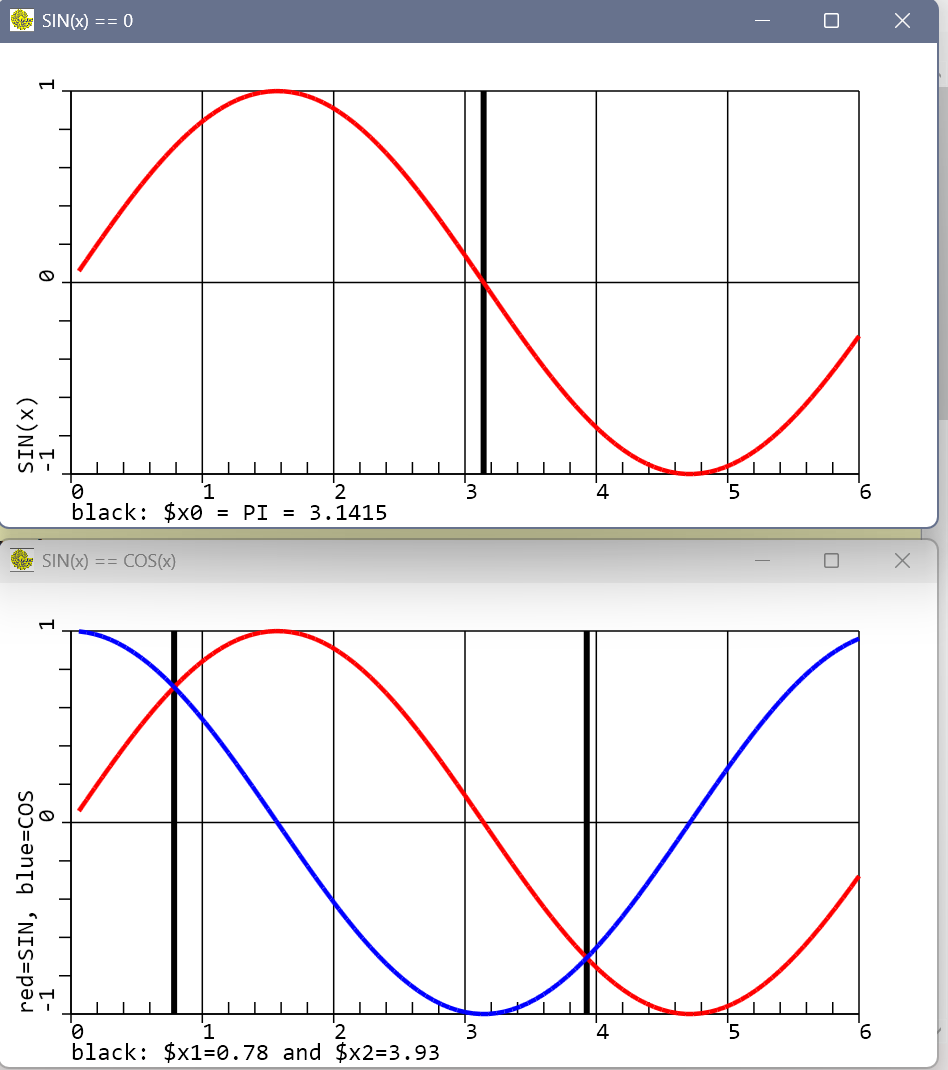
F3() ! plot SIN and $x0 == pi

. find x=$x1 for   SIN(x) = COS(x)   between x=0 and x=3
$x1 = ROOT("y=SINeqCOS(x)", "dy=dSINeqCOS(x)", 0, 3)
SINeqCOS($x1) ! x1 should be close to zero

. find x=$x2 for   SIN(x) = COS(x)   between x=3 and x=6
$x2 = ROOT("y=SINeqCOS(x)", "dy=dSINeqCOS(x)", 3, 6, 1E-15, 100)
SINeqCOS($x2) ! x2 should be close to zero
F4() ! plot SIN and COS and $x1 and $x2

DLG(T=0.9, B="Quit HicEst",Y=0,X=1,BG=900)
IF($txtRC == "Quit HicEst") SYSTEM(Quit=1)
END

FUNCTION SINeqNULL(xx)
    SINeqNULL = SIN(xx)
END
FUNCTION dSINeqNULL(xx)
    dSINeqNULL = COS(xx)
END

FUNCTION SINeqCOS(x)
    SINeqCOS= SIN(x) - COS(x)
END
FUNCTION dSINeqCOS(x)
    dSINeqCOS = COS(x) + SIN(x)
END

FUNCTION F3() ! plot SIN
    SET(xmin=0, xmax=6)
    xtitle = "black: $x0 = PI = 3.1415"
    DLG(TI="SIN(x) == 0", Rows=2,Cols=2, Ax=2,TI=xtitle, Min=xmin,Max=xmax, Y=0,TI="SIN(x)", MIN=-1,Max=1)
    DO i = 1, 100
        X(i) = xmin + i * (xmax - xmin) / 100
        sinus(i) = SIN(X(i))
    ENDDO
    LINE(Ax=2, X=$x0,Y=-1,Draw=-1, Y=1,W=4,Draw=0)
    LINE(Ax=2, XVec=X, YVec=sinus, Width=3, Draw=900)
END

FUNCTION F4() ! plot SIN and COS
    SET(xmin=0, xmax=6)
    xtitle = "black: $x1=0.78 and $x2=3.93"
    DLG(TI="SIN(x) == COS(x)", Rows=2,Cols=2, Ax=4, Min=xmin,Max=xmax,TI=xtitle, Y=0,TI="red=SIN, blue=COS", MIN=-1,Max=1)
    DO i = 1, 100
        X(i) = xmin + i * (xmax - xmin) / 100
        sinus(i) = SIN(X(i))
        cosinus(i) = COS(X(i))
    ENDDO
    LINE(Ax=4, X=$x1,Y=-1,Draw=-1, Y=1,Width=4,Draw=0)
    LINE(Ax=4, X=$x2,Y=-1,Draw=-1, Y=1,Width=4,Draw=0)
    LINE(Ax=4, XV=X, YVec=sinus, W=3, Draw=900, YVec=cosinus, W=3, Draw=9)
END

#Describe
. This sample solves the equations for x

.	SIN(x) = 0, x <= 0.001 <= 6
.	SIN(x) = COS(x), x1 <= 0 <= 3
.	SIN(x) = COS(x), x1 <= 3 <= 6

. Call ROOT:
.	xZero = ROOT("y=func(x)", "dy=dFunc(x)",
.		 [lower, upper, precision, maxIters, ivalParts])
.		"y=func(x)"	= Function to get roots from (obligatory)
.		"y=dFunc(x)"	= 1st derivative of func (obligatory)
.				 (See script on how to build func and dFunc)
.		lower		= lower bound for root, default=0 (optional)
.		upper		= upper bound for root, default=1 (optional)
.		precision 	= Desired accuracy, default=1E-8 (optional)
.		maxIters 	= maximum iterations

. Results are plotted with functions F3 and F4.
. (F functions can be called with its key or by mouse)

. The Newton-Raphson algorithm
. is used the find the roots of
.	func(x) = 0
###